

Virtual Private Servers Saudi Arabia
Cloud VPS hosting from Riyadh and Jeddah with full root or Administrator access, a Saudi Arabian IPv4 address and monthly billing. Five plans from 2 GB to 32 GB of RAM, ready for Linux or Windows.
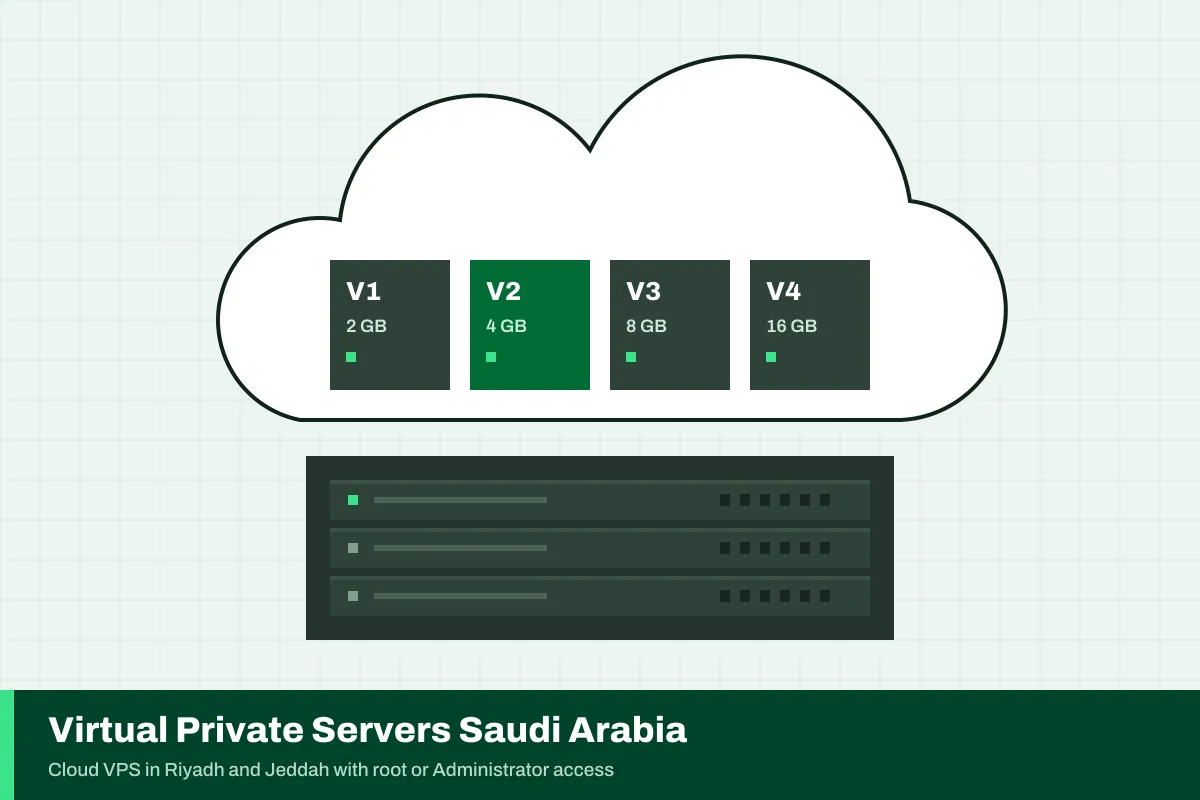
Saudi VPS plans and monthly prices
Every plan includes a Saudi IPv4 address, root or Administrator login, free OS reinstalls and basic support. Prices are in US dollars per month.
| Plan | Storage | RAM | vCPU | Bandwidth | Monthly price | Order |
|---|---|---|---|---|---|---|
| V1 | 50 GB | 2 GB | 1 | 1 TB – unmetered | $44/mo | Buy VPS |
| V2 | 50 GB | 4 GB | 2 | 1 TB – unmetered | $79/mo | Order VPS |
| V3 | 50 GB | 8 GB | 4 | 2 TB – unmetered | $159/mo | Purchase VPS |
| V4 | 50 GB | 16 GB | 8 | 2 TB – unmetered | $219/mo | Deploy VPS |
| V5 | 50 GB | 32 GB | 16 | 2 TB – unmetered | $368/mo | Powerful VPS |
Customers on older VPS plans: as announced in our earlier notice, packages other than those listed above are charged USD 1.25 per GB for bandwidth beyond their allowance. Ask us about moving to a current plan to get a larger transfer quota.
Included with every virtual server
Each plan is built on Supermicro server hardware with redundant storage, and the same set of features applies from V1 to V5. Pick the size that matches your workload; the platform stays the same.
- Supermicro host servers
- Full root or Administrator access
- Redundant storage arrays
- Fast cloud provisioning
- Free operating system reinstalls
- 1 TB to unmetered bandwidth options
- Linux and Windows images
- Dedicated VPS control
- Basic support by ticket
Your own environment
Manage your node without sharing it with anyone else, with no third party touching your configuration.
Resize when you need to
Start on the first plan and upgrade later, or ask for a custom mix of CPU, RAM and storage.
Activated quickly
Orders are provisioned on priority once payment is confirmed, usually well inside 24 hours.
Clean reinstalls
Switch operating systems or start over with a fresh image at no charge through a ticket.
On this page
Everything worth knowing before you run production software on a Saudi VPS.
Saudi virtual servers for latency-sensitive applications
A virtual private server splits a powerful physical host into isolated machines, each with its own operating system, reserved memory and processor threads. Because the slice belongs to you, nothing another customer runs can steal your RAM or fill your disk. That predictability is why a VPS is the default choice for applications that must answer quickly every time, such as payment callbacks, chat backends and live dashboards.
Hosting that VPS inside Saudi Arabia adds a second advantage: your packets stay on regional networks instead of crossing to Frankfurt or Amsterdam. Users on STC, Mobily and Zain connections reach your server in fewer hops, so API calls finish faster and remote desktop sessions feel immediate. For teams building for the Saudi market, that combination of isolation and proximity is hard to match with overseas cloud providers, where the nearest region may still be a border away and billed by the gigabyte for every byte that leaves. Local hosting also keeps support conversations in your time zone.
Local hosting simply removes friction.
Sizing CPU, RAM and storage for your workload
Start by looking at what actually consumes resources. A WordPress or Laravel site with modest traffic runs comfortably on V1 with 2 GB of RAM, provided you enable caching. Online shops with several thousand products, or sites using Elasticsearch, are happier on V2 or V3, where the database can hold more of its working set in memory.
Windows Server needs more headroom than Linux because the operating system alone uses roughly 2 GB. For a Windows VPS hosting an accounting package or a few remote desktop users, V2 is a realistic minimum and V3 is better if several people connect at once.
Processor count matters most for workloads that run in parallel: video transcoding, build servers, game servers and busy PHP-FPM pools. If your monitoring shows the CPU pinned at 100 percent for long periods, moving up a plan doubles the cores. Our team can review your current server graphs and suggest a size before you migrate, which avoids paying for an oversized plan in the first months.
Measure before you buy more.
Root access, operating systems and your responsibilities
Every plan comes with full root access on Linux or Administrator access on Windows. You can install any software stack, compile your own kernel modules where supported, and open whichever ports your application needs. That freedom comes with responsibility: patching the operating system, configuring a firewall, rotating passwords and taking backups are tasks you own on an unmanaged VPS.
We provide current images of Ubuntu LTS, Debian, AlmaLinux and Rocky Linux, plus Windows Server. CentOS 7 and CentOS 8 have reached end of life and no longer receive security updates, so we recommend AlmaLinux or Rocky Linux for anyone migrating older RHEL-style servers.
A sensible first hour on a new VPS looks like this: update all packages, create a non-root user with SSH keys, disable password logins, enable a firewall such as UFW or firewalld, and install Fail2ban. On Windows, run Windows Update, rename the Administrator account and restrict RDP by source IP. These steps block the vast majority of automated attacks.
Small, consistent habits prevent big security incidents later.
Bandwidth, IP addresses and network quality
Data transfer within the Kingdom costs more than in many other regions, which is why some local providers cap VPS bandwidth at a few hundred gigabytes. Our plans include 1 TB on V1 and V2 and 2 TB on V3 and above, and the allowance can be raised when your project needs it.
Each VPS receives one dedicated Saudi IPv4 address. Additional addresses are available when you can show a technical need, such as separate SSL endpoints or isolated services, in line with regional registry policy. Reverse DNS can be set to your hostname on request, which is important if the server sends email.
Our nodes connect through multiple upstream carriers, so traffic reroutes automatically if one provider has an outage. Network-level DDoS filtering absorbs common volumetric attacks before they reach your virtual machine. Larger or application-layer attacks may still require tuning inside the server, and our team will help you identify the traffic pattern when that happens, and can null-route an attack target temporarily to protect the rest of the network.
Ask us about your traffic profile.
Scaling up, migrating in and moving between plans
Growth on a VPS is straightforward. When you need more memory or cores, request an upgrade from the client area and the price difference is prorated for the rest of your billing month. Most upgrades need only a short reboot, and your IP address, files and configuration stay exactly as they were.
Moving an existing site to us usually follows a simple path. We deliver the new VPS, you copy files and databases across using rsync, a panel transfer tool or a backup restore, and then test the site using a hosts-file entry before touching DNS. Once everything works, lower the TTL on your DNS records, switch the A record to your Saudi IP and keep the old server running for a day while caches expire.
If your project later outgrows a single VPS, the next step can be a second VPS for the database, or a move to one of our dedicated servers. Either way, you stay with the same support team and client account, and we can help plan the split so downtime stays minimal.
Growth never means starting over.
Data centres in Jeddah and Riyadh
Our Saudi VPS platform runs in two of the Kingdom's main connectivity hubs. Riyadh is home to most government and enterprise traffic, while Jeddah sits close to the Red Sea submarine cable landings that link the country to Europe, Africa and Asia. Choosing the city closer to your users trims a few more milliseconds off every request.
Both locations offer Tier III class power and cooling, multiple network carriers and on-site engineers. If you serve customers nationwide, either city delivers low latency across the Kingdom; if you need geographic redundancy, run one VPS in each and balance traffic between them.
- Redundant power and generators
- Multiple upstream carriers
- On-site hardware replacement

Typical projects on a Saudi VPS
E-commerce backends
Stores built on WooCommerce, Magento or a custom framework, where checkout speed and a local IP help payment gateway approvals.
Windows remote desktops
Small offices running accounting software, POS back offices or trading terminals that staff open over RDP from across the Kingdom.
Containers and microservices
Docker or Podman stacks with Nginx or Traefik in front, ideal for APIs that mobile apps in the region call thousands of times a day.
Agency multi-site hosting
One VPS with a control panel hosting many client sites, each with its own PHP version and SSL certificate.
VPN and private networking
WireGuard or OpenVPN gateways for teams that need a stable Saudi exit IP for whitelisted business systems.
Staging and development
A low-cost V1 mirrors production so developers can test updates against the same location and software versions.
Linux VPS or Windows VPS: which should you pick?
Both run on the same hardware and network. The right choice depends on the software you need and the skills on your team.
Choose Linux when
You host PHP, Node.js, Python or Go applications, run Docker containers, or want the lowest resource overhead. Linux distributions are free, so the whole plan budget goes to performance rather than licences. Ubuntu and Debian have the widest community documentation, while AlmaLinux and Rocky Linux suit teams used to Red Hat tools and cPanel. Administration is mostly done over SSH, and a 2 GB plan already runs a tuned web stack comfortably.
Choose Windows when
Your software only runs on Windows, such as ASP.NET Framework sites, MSSQL databases, MetaTrader terminals or desktop accounting packages shared over Remote Desktop. Windows Server is managed through a familiar graphical interface, which helps teams without Linux experience. Plan for at least 4 GB of RAM, keep Windows Update running every month, and remember that licence costs for the operating system and any additional RDP user licences are billed on top of the VPS price.
Prefer a VPS in the UAE instead?
If your audience is centred on Dubai and Abu Dhabi, or you want a second Gulf location for redundancy, our sister service runs virtual private servers from a mature Dubai data centre at lower monthly prices. The plans offer the same root access and Linux or Windows choice, so moving between the two locations is simple.
What makes our VPS platform dependable
- Server-grade nodes reserved for virtual machines
- Upgrade or downgrade resources whenever you need
- Add extra RAM, disk or IPs as separate options
- Network built for a 99.9% uptime SLA
- Support staff who answer in plain language
Test a VPS before moving production traffic
The best way to judge any server is to measure it with your own workload. After your VPS is delivered, spend an hour running simple checks before you migrate. Ping and traceroute from the offices or cities where your users are to see real latency. Run a disk benchmark such as fio and a CPU test such as sysbench to establish a baseline you can compare against later.
Next, deploy a copy of your application and load test it with a tool like k6 or ApacheBench, increasing concurrent users until response times climb. That tells you how much traffic the plan can absorb and whether a larger size is worth it. Keep the results; if performance ever seems to change, you will have numbers to compare instead of impressions.
If anything looks wrong during testing, open a ticket with the output. We would much rather investigate before you go live than after customers notice.
Popular VPS add-ons
- Extra IPv4 address
- Additional RAM
- More disk space
- Extra bandwidth
- cPanel/WHM licence
- Plesk licence
- Windows Server licence
- Custom configuration
Add-ons appear in the order form with their monthly price, or can be requested later from the client area.
Monitoring uptime on your virtual server
Because a VPS is unmanaged, it is worth setting up your own monitoring from day one. A free external uptime checker can alert you by email or messaging app if your website or API stops responding, while an agent inside the server can watch disk space, memory and running services. Alerts that arrive before customers notice a problem turn a potential outage into a routine fix. If an alert points to the network or hardware rather than your software, open a ticket with the timestamps and we will check our side immediately.
VPS questions, answered
Can I install my own control panel on a Saudi VPS?
Yes. With root access you can install cPanel/WHM, Plesk, DirectAdmin, CyberPanel or any free panel yourself, or ask us to add a licensed panel to your order. Licence fees are charged by the panel vendor and are added to your monthly invoice.
Is Remote Desktop enabled on Windows VPS plans?
Windows Server images are delivered with Remote Desktop switched on and the Administrator password in your welcome email. We recommend changing the default RDP port, enforcing strong passwords and limiting access by IP straight away, because public RDP ports attract automated login attempts.
What happens if I use more bandwidth than my plan includes?
Each plan lists its included monthly transfer. If a project regularly needs more, ask us to raise the allowance on your plan. Customers still on older legacy VPS packages are billed for extra transfer at USD 1.25 per GB, as announced in our earlier notice.
Can I reinstall the operating system myself?
OS reinstalls are free. Open a ticket naming the image you want, such as Ubuntu 24.04, Debian 12, AlmaLinux 9 or Windows Server, and our team will rebuild the VPS. A reinstall erases the disk, so download your files first.
Do you take backups or snapshots of my VPS?
VPS plans do not include automatic backups. You should schedule your own backups to storage outside the server, for example an S3-compatible bucket or your office NAS. Paid backup space can be discussed through a ticket if you need it.
Can I order a custom amount of RAM or storage?
Yes. If none of the five plans fits, describe the CPU, RAM, disk and bandwidth you need and we will quote a custom configuration. Additional storage, IPv4 addresses and RAM can also be added to an existing plan.
Can I run an email server on the VPS?
You can, but outgoing mail reputation is your responsibility. Configure SPF, DKIM, DMARC and reverse DNS before sending, and never send bulk unsolicited mail. Spam complaints lead to suspension under our Terms and Conditions.
Which city will my VPS be located in?
Saudi VPS nodes run in data centres in Riyadh and Jeddah. If you have a preference, mention it in the order notes and we will place your server there when capacity allows.